
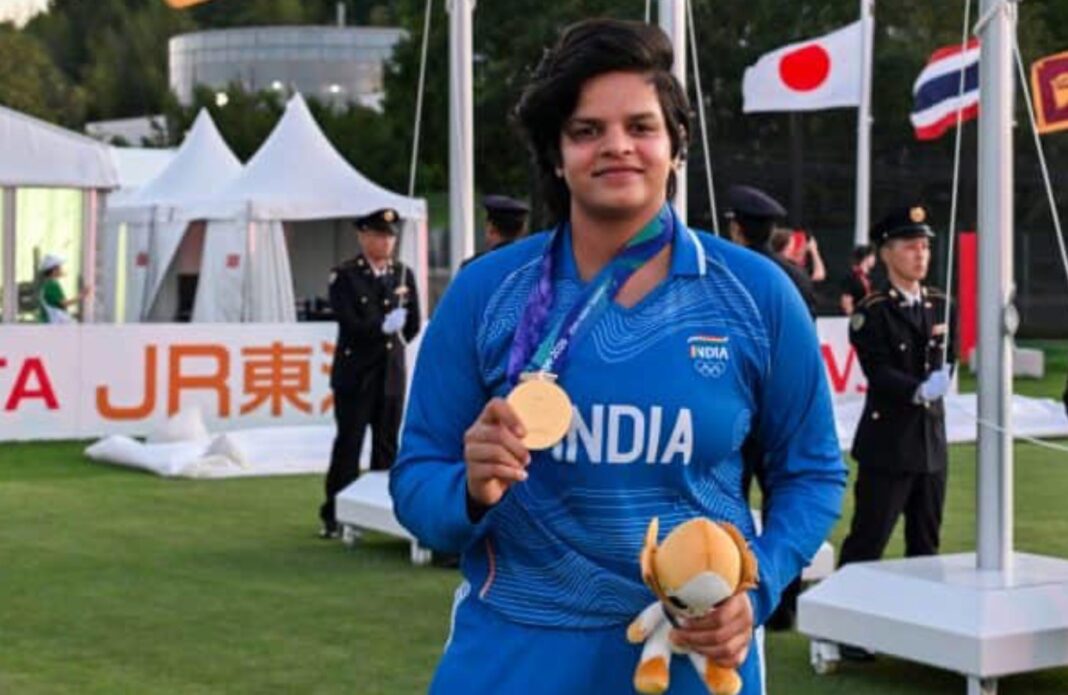

Shafali Verma has created history in women’s T20I cricket, surpassing Laura Wolvaardt’s record for the most runs scored by a batter in a calendar year. The Indian opener reached the landmark during the Asian Games 2026 gold-medal match against Sri Lanka.
India opener Shafali Verma added another major milestone to her remarkable 2026 campaign on Tuesday, September 22, becoming the highest run-scorer in women’s T20 internationals in a single calendar year.
Shafali achieved the record during India’s Asian Games 2026 gold-medal clash against Sri Lanka at Korogi Sports Park in Nisshin, Japan.
She entered the final needing just 10 runs to move past South Africa captain Laura Wolvaardt, who had previously held the record with 824 runs.
Shafali reached the mark during the opening stages of her innings, crossing Wolvaardt’s tally on the seventh ball she faced.
Shafali Breaks the Record in Explosive Fashion
The Indian opener did not merely reach the milestone before moving on. She produced another aggressive innings, scoring 48 runs from 29 balls.
Her knock included three boundaries and three sixes, giving her a strike rate of 165.52.
The performance took Shafali’s 2026 international tally to 863 runs from 24 matches, at an average of 39.22 and an overall strike rate of 162.83, according to the supplied statistics.
Most Runs in a Calendar Year in Women’s T20Is
| Runs | Player | Team | Year |
|---|---|---|---|
| 863 | Shafali Verma | India | 2026* |
| 824 | Laura Wolvaardt | South Africa | 2026 |
| 800 | Natasha Miles | Hong Kong | 2026 |
| 779 | Esha Oza | UAE | 2025 |
| 779 | Yasmin Daswani | Hong Kong | 2026 |
Figures based on the match information supplied.
Shafali’s Knockout-Stage Form Continues
The record-breaking performance was another strong showing from Shafali in high-pressure knockout matches.
Her recent tournament performances have included several substantial scores, with the Indian opener consistently producing aggressive innings when the stakes have been high.
Her reported scores across the cited knockout fixtures include:
- 64 off 40 vs Bangladesh — Asia Cup semi-final
- 68 off 39 vs Sri Lanka — Asia Cup final
- 40 off 15* vs Japan — Asian Games quarter-final
- 100 off 49* vs Bangladesh — Asian Games semi-final
- 48 off 29 vs Sri Lanka — Asian Games final
Across those five matches, Shafali accumulated 407 runs at an average of 101.75, while maintaining a strike rate above 180, based on the supplied figures.
The sequence underlines her impact during the latter stages of tournaments and adds context to her record-setting calendar year.
Shafali and Smriti Mandhana Reach Another Milestone
The Asian Games final also produced another landmark for Indian women’s cricket.
During India’s opening partnership of 99 runs against Sri Lanka, Shafali and Smriti Mandhana became the first opening pair in women’s T20I cricket to surpass 4,000 aggregate partnership runs, according to the supplied statistics.
The pair’s total subsequently reached 4,080 partnership runs across 107 matches.
They are followed on the all-time list by UAE’s Esha Oza and Theertha Satish, who have 2,949 partnership runs, while Australia’s Alyssa Healy and Beth Mooney have 2,720.
Most Partnership Runs by a Women’s T20I Opening Pair
| Opening pair | Partnership runs |
|---|---|
| Shafali Verma & Smriti Mandhana | 4,080 |
| Esha Oza & Theertha Satish | 2,949 |
| Alyssa Healy & Beth Mooney | 2,720 |
A Record-Breaking Year for Shafali Verma
Shafali’s latest achievement adds another statistical milestone to a year in which she has repeatedly produced impactful performances for India.
Her aggressive approach at the top of the order has made her one of the team’s key run-scorers in the shortest format, while her performances in tournament knockout matches have further strengthened her 2026 numbers.
By moving beyond Wolvaardt’s previous mark of 824 runs, Shafali now holds the record for the most women’s T20I runs in a calendar year, with her tally standing at 863 after the Asian Games final.
With the calendar year still underway, her final 2026 tally could rise further.