
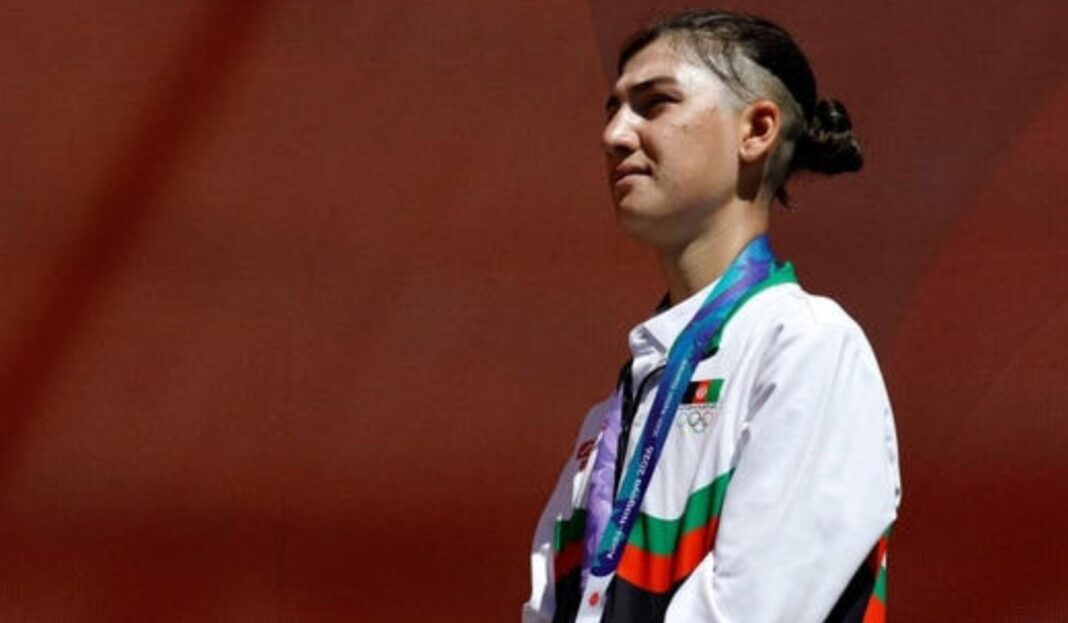

Fariba Hashimi, who fled Afghanistan after the Taliban returned to power in 2021, has won silver in the women’s individual road race at the Asian Games 2026. Her medal marks a landmark moment in her career and for Afghan women’s cycling.
Five years after leaving Afghanistan, Fariba Hashimi stood on an Asian Games podium.
The 23-year-old Afghan cyclist won silver in the women’s individual road race, becoming Afghanistan’s first female Asian Games medallist since 2002, according to the supplied report.
For Hashimi, the medal carries significance far beyond the result. Her journey into international cycling began in circumstances where simply riding a bicycle was difficult and, according to her accounts, dangerous.
“I came to the Asian Games dreaming about standing on the podium and representing my country. I can’t explain my feelings now.”
Hashimi, a Paris 2024 Olympian, had earlier finished seventh in the women’s individual time trial at these Games.
From Faryab to the Asian Games Podium
Hashimi grew up in Faryab, an isolated province in northern Afghanistan, where she began cycling at the age of 15.
Her older sister Yulduz Hashimi, who also became an international cyclist, introduced her to the sport.
Neither sister initially owned a bicycle. They borrowed one from a neighbour and learned to ride before entering their first race in 2017.
The sisters reportedly disguised themselves using headscarves, masks and sunglasses so they could compete.
Fariba won that first race, while Yulduz finished second.
Recalling the experience, Hashimi told the BBC:
“I felt like a bird who could fly. It felt amazing.”
The Sisters Trained in Disguise
Cycling subsequently became a much bigger part of the sisters’ lives, but Hashimi said they had to conceal their identities while training and racing.
“No one ever thought that women would ride bicycles in Faryab. We thought it would be small, but it caused quite a stir. I always dressed as a man to go to train.”
As the sisters attracted attention, Hashimi said their training became increasingly difficult.
She described facing verbal abuse and attacks involving stones and bottles, as well as surveillance.
“They were trying to make us go home by being aggressive and attacking us,”
Hashimi said.
She also recalled an incident involving her sister Yulduz, who was reportedly struck by a rickshaw while cycling and suffered a broken wrist.
The experiences made cycling a risky pursuit for the sisters, but they continued.
‘In Afghanistan, This Kind of Freedom Does Not Exist’
Hashimi has spoken about the fears her family had over her decision to continue cycling.
Recalling a conversation with her father before a race, she said:
“Once before a race, my father asked me, ‘Do you want to ride? I’m fine with it, but I’m afraid they might kill you’.”
Hashimi added:
“In Afghanistan, this kind of freedom does not exist.”
She has also stressed that her criticism is directed at restrictions on women’s freedom rather than Afghan people themselves.
“I had a really bad time, but I’m not saying my people are bad. We’ve got such a wonderful country. But the mentality is different.”
Hashimi Left Afghanistan After Taliban Return
Hashimi left Afghanistan in 2021, following the Taliban’s return to power, and eventually settled in Italy.
She now trains there with support from Alessandra Cappellotto, the former world champion cyclist.
Her departure marked a major turning point in her sporting career, allowing her to continue competing internationally.
Hashimi later represented Afghanistan at the Paris 2024 Olympics and has now added an Asian Games silver medal to her record.
‘This Silver Medal Can Show a Lot of Resilience’
Hashimi hopes her achievement can encourage women and girls who face barriers to pursuing their ambitions.
“This silver medal can show a lot of resilience from Afghan women,”
she said.
The cyclist also emphasised that she sees her achievement as part of something larger than her own sporting journey.
“I’m not alone. I know that behind me are millions of women, from many countries, who have the same dream. They are standing with me.”
Her comments come against a backdrop of continuing restrictions on girls’ and women’s access to education and public life in Afghanistan. The supplied report cites UNESCO as estimating that 2.4 million Afghan girls have been excluded from secondary education since the change of power.
From Hiding on a Bicycle to an Asian Games Podium
Hashimi’s Asian Games silver represents a striking transformation from the teenager who once had to disguise herself simply to compete in a cycling race.
She began by borrowing a bicycle in Faryab and racing alongside her sister. Years later, she became an Olympian, established herself on the international cycling circuit and reached the Asian Games podium.
For Hashimi, the medal is therefore not simply another sporting achievement.
It is also a reminder of the journey that brought her from a place where she said women’s freedom to cycle was severely restricted to an international podium where she could represent Afghanistan.
“I’m really happy because this silver medal can show a lot of resilience from Afghan women,”
Hashimi said.