
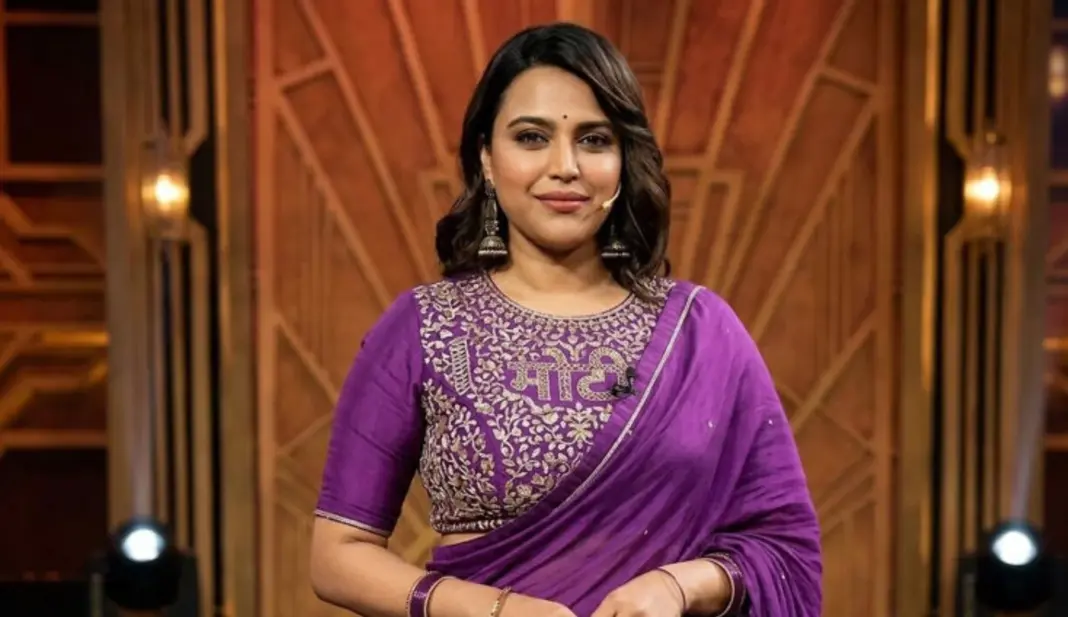

Actor Swara Bhasker made a pointed statement about postpartum body shaming during her appearance on the reality show Rise and Fall. Rather than ignore the comments she has faced about her appearance since becoming a mother, the actor chose to put those words at the centre of her look.
For the show’s premiere, Swara wore a purple saree paired with a blouse carrying the word “moti”, a Hindi term commonly used to describe someone as overweight or fat. The choice was presented as a way of reclaiming a label that has repeatedly been directed at her online.
Speaking with host Virender Sehwag, Swara opened up about the criticism she has received since the birth of her daughter. She explained that social media users have repeatedly commented on her body and compared her to various animals because of her appearance.
Rather than allowing those remarks to define how she sees herself, Swara said she has reached a stage where she can acknowledge the words and take away some of their power.
Swara Bhasker Responds to Years of Online Body Shaming
Swara’s appearance on Rise and Fall was not simply a fashion moment. It reflected a broader conversation she has previously had about the pressure placed on women to regain their pre-pregnancy bodies.
According to her account, strangers online have subjected her to a series of insulting comparisons since she became a mother. Among the words she recalled were references to a buffalo, cow, hippo and elephant.
The actor’s decision to incorporate “moti” into her outfit effectively turned one of those insults into a visible part of her public appearance.
Instead of attempting to hide the physical changes associated with motherhood, she used the moment to question why women are expected to maintain a particular appearance even after major life changes.
Her Message Goes Beyond a Reality Show Outfit
Swara has spoken about body image and postpartum expectations outside reality television as well.
Earlier this year, she responded on social media after receiving insensitive comments about a photograph from 2018. The criticism again centred on her appearance and prompted her to discuss the expectation that women should quickly return to their pre-pregnancy bodies.
Her argument was that there is no universal deadline by which a woman is required to lose weight after giving birth.
She also questioned the idea that a woman’s body should primarily be judged according to its appearance, glamour or sexual appeal. For Swara, motherhood represents a significant physical and emotional transition, and expecting a woman to immediately look exactly as she did before pregnancy can create unnecessary pressure.
‘Bouncing Back’ After Pregnancy
The phrase “bounce back” is frequently used when discussing women’s bodies after childbirth, but Swara has challenged the thinking behind that expectation.
In her earlier reflections, she acknowledged that people can naturally miss aspects of their younger selves, including a slimmer physique. However, she argued that constantly comparing the present body with an earlier version and attempting to force it back into an old standard can become another source of distress.
Her comments also point to a larger issue surrounding the way female celebrities are scrutinised.
Public figures routinely face commentary about weight, ageing, clothing and physical appearance. For actresses who become mothers, that scrutiny can become particularly intense, with audiences sometimes expecting them to return to their previous appearance almost immediately.
Swara’s approach on Rise and Fall turns that conversation around. Instead of presenting postpartum changes as something that needs to be concealed, she has chosen to acknowledge them publicly.
Swara Uses Fashion to Challenge the Conversation
The purple saree and “moti” blouse therefore carried a message beyond its visual appeal.
By displaying a word that had been used against her, Swara transformed an insult into part of her own presentation. The move allowed her to address body shaming without presenting herself as someone who needs to apologise for the way her body has changed.
Her stance also reflects a wider shift in conversations around postpartum bodies. While celebrities have traditionally faced pressure to quickly return to a particular physical ideal, more public discussions are now questioning whether that expectation is realistic or necessary.
For Swara, the central issue is not whether someone changes physically after pregnancy. It is why strangers feel entitled to dictate what that body should look like or how quickly it should change.
Swara Bhasker on Accepting Life After Motherhood
Swara’s comments suggest that accepting the changes that come with motherhood does not mean denying one’s past or personal preferences. Instead, she has emphasised the importance of recognising that life after childbirth can be fundamentally different from life before it.
That distinction is at the heart of her response to body-shaming comments.
Rather than treating her postpartum body as a problem that needs to be corrected, Swara has used her public platform to question the standards being applied to it.
Her Rise and Fall appearance consequently became another chapter in an ongoing conversation she has been having about motherhood, body image and the expectations placed on women in the public eye.
What Is Rise and Fall About?
Rise and Fall is a reality competition hosted by former Indian cricketer Virender Sehwag. The show features contestants including Swara Bhasker, Karan Patel, Priyanka Chahar Choudhary and Gautam Gulati.
The programme combines competition, strategy and social dynamics, giving contestants an opportunity to make their personalities and viewpoints part of the entertainment.
Swara’s comments on the premiere added a personal dimension to the programme, turning a reality-show appearance into a discussion about an issue she has repeatedly addressed in public.
For the actor, the message behind the outfit was clear: words intended to shame her do not have to determine how she sees herself.