
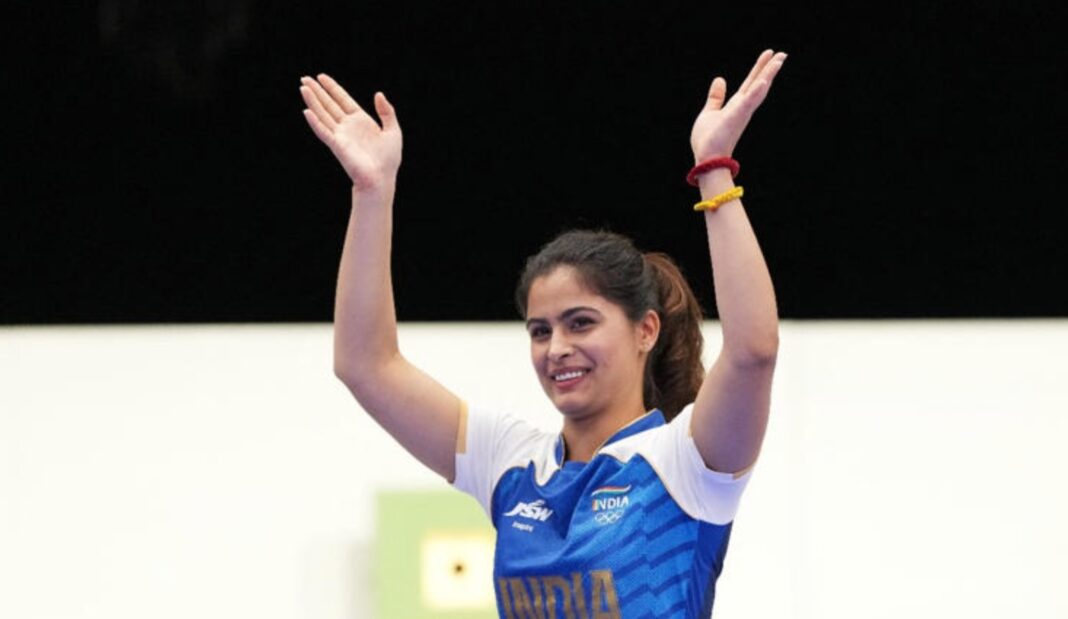

Manu Bhaker struggled to hold back tears while remembering her late mentor Jaspal Rana after finishing fifth in the women’s 10m air pistol final at the Aichi-Nagoya Asian Games on Wednesday. It was Bhaker’s first major multi-sport event since Rana’s death in June.
Manu Bhaker’s return to the Asian Games ended without an individual medal, but the result became only part of an emotional evening for the Indian shooter.
The 24-year-old finished fifth in the women’s 10m air pistol final in Aichi-Nagoya on Wednesday. Soon after the competition, she was asked about her former coach and mentor Jaspal Rana, who died aged 49 in June after cardiac issues.
Bhaker became visibly emotional while recalling the influence Rana had on her career and the lessons he left behind.
“If I remember all those years… it’s not that you remember once or twice, it stays with you. When a person has been a big part of your life, it stays,” Bhaker said.
Jaspal Rana’s Influence on Manu Bhaker
Rana played a significant role in Bhaker’s development as a shooter and was part of the coaching team that helped guide her to two bronze medals at the Paris Olympics in 2024.
Rana was also an accomplished Asian Games shooter himself. Across three editions of the continental Games, he won eight medals, including four golds, making him one of India’s most successful shooters at the event.
For Bhaker, however, Rana’s influence extended beyond medals and technical aspects of shooting.
She recalled his insistence on concentrating on the process rather than becoming consumed by the final result.
“He was just so adamant on process always — that you have to be able to, any given day, any given point in your life, whenever you shoot, you have to be able to give your best performance and follow your process,” she said.
That philosophy remained central to Bhaker’s approach during the Asian Games.
An 8.9 Ends Bhaker’s Medal Challenge
Bhaker entered the women’s 10m air pistol final with medal hopes, but an 8.9 on her eighth shot significantly affected her position and ultimately left her outside the podium places.
Reflecting on the moment, she acknowledged its impact on her medal chances.
“As much as anyone wants to deny it, yes, it definitely compromised the chances a lot,” Bhaker said.
Despite the setback, she maintained that following her process had remained her primary objective throughout the competition.
“My process was the number one thing and I was able to do that in qualification and also in the finals,” she explained.
Bhaker said that most of her shots followed the process she had planned, although a few executions did not go as intended.
Difficult Preparation Before the Final
Bhaker also revealed that her preparation in Japan had not been entirely smooth.
She described Tuesday’s pre-training session as particularly challenging, saying she struggled with several aspects of the session and had difficulty seeing the sighters properly.
“I had some issues like yesterday the PT (pre-training) was not good at all – lots of struggle, lots of things and I was not able to see the sighters properly,” she said.
Even with those difficulties, Bhaker said she was able to focus on her process during qualification and the final.
She also compared her performance in Aichi-Nagoya with simulated finals she had competed in during preparations in Bhopal, saying she felt her Asian Games performance was slightly better.
Rana’s Absence Was Felt in Japan
The Asian Games carried additional emotional significance for Bhaker because of Rana’s absence.
She recalled looking forward to competing in Japan and remembered Rana’s stature within Asian shooting.
“Of course, he was like the Asian champion, he was like the best of the best. When I came to the Asian Games (in 2018 Jakarta), I think he was like the undisputed champion and yes I was really looking forward to Japan actually and the circumstances were,” she said before pausing.
Bhaker also remembered advice from Rana that went beyond sport.
“Life is very unpredictable and live it to the fullest, be kind and everything,” she recalled.
The memory became particularly poignant as Bhaker reflected on competing at an Asian Games without the mentor who had been an important part of her journey.
Manu Bhaker Credits Her Current Support Team
Bhaker also acknowledged the people currently working alongside her, including Serbian coach Jelena Arunovic.
She highlighted the effort involved behind an athlete’s performance, pointing out that the attention often falls on the competitor while a larger support team works behind the scenes.
“You just see me, but so many people work so hard so that we are able to perform,” Bhaker said.
She also praised Arunovic for her patience and dedication during the preparation period.
Bhaker Remains Positive After Fifth-Place Finish
Although Bhaker left the women’s 10m air pistol final without an individual medal, she did not view the result as the end of her Asian Games campaign.
She said she remained grateful for the experience and believed there was room to improve.
“I’m positive that in future I can do even better and can keep improving.”
She later added:
“I’m very grateful and I really hope I can do better.”
For Bhaker, the Aichi-Nagoya competition therefore became about more than a fifth-place finish. It was also her first Asian Games appearance since the loss of Jaspal Rana, whose emphasis on discipline, process and consistency continues to shape the way she approaches competition.